Not My Idea of Travel

Cruise Ship Traveler “Discovers” Chichén Itzá

I may be revealing myself to be a grouch, but I dislike American travelers who spend the money to visit another country and don’t take the trouble to understand anything of the culture, history, or language of the countries they visit. These are the travelers who, when they ask me questions, get answered in Hungarian.

Perhaps I take my travel too seriously. For instance, when I visited Guatemala in 2019, I read nineteen books on the subject starting in February 2018. Although I frequently hired English-speaking guides at the ruins, I was at the knowledge level of a graduate student in archaeology, with a minor in history and geography.

I keep thinking of a pediatrician friend of mind who went to Europe for the first time with her fiancé and spent only a day or two in each country, just walking around and not even making an attempt to concentrate on the most interesting sights. She wound up marrying the guy and divorcing him shortly thereafter. She felt cheated, having spent so much money and seeing nothing.

It’s like visiting the Grand Canyon and spending all your time walking around the shops and restaurants in Grand Canyon Village.

Looking at the picture above, which was taken from a current American Automobile Association (AAA) travel catalog, I wonder if the young lady standing by the Maya pyramid considered the possibility of sunstroke. Of all the thousands of people who visit Chichén Itzá every day, she was probably the only person not wearing a hat.

Looking more closely at the AAA catalog, I noticed that the ruins are an optional side trip from Cozumel, which is 2-3 hours from Chichén by ferry and bus. The grounds are extensive, as the ruins occupy several square miles. If I had to spend 4-6 hours in transport alone, I would not have much time at the ruins before having to return to my cruise ship. (I spent three days and two nights at a hotel near the ruins on my last trip there.)

Attack of the Januarius Monsters

Lobby Card for Roger Corman’s Attack of the Crab Monsters

On January 2 of this year, I posted a blog entitled Januarius 2026 in which I stated my intention of reading only books written by authors new to me. At that point, I mentioned a number of authors I was planning to attempt. It is my sad task to tell you that I read only two of the books I mentioned: Colson Whitehead’s The Underground Railroad and Worst Journeys: The Picador Book of Travel.

In all, I read twelve books in January. In addition to the two mentioned above, the list included, in order:

  • Peter Cheyney’s This Man Is Dangerous, introducing the character of Lemmy Caution, which was taken up by Jean-Luc Godard in his film Alphaville
  • Ludvík Vaculík’s Cup of Coffee with My Interrogator, A: The Prague Chronicles of Ludvík Vakulík, a Czech novelette about the last days of Communism in Prague
  • Miklós Vamos’s The Book of Fathers, a fat novel about twelve generations of Magyars surviving (or not surviving) two centuries of Hungarian history
  • Stuart Stevens’s Night Train to Turkistan: Modern Adventures Along China’s Ancient Silk Road, definitely a “Worst Journey” to Western China and the Uighurs
  • Marivaux’s Infidelities, an 18th century French play about true love
  • Patrick Marnham’s So Far from God: A Journey to Central America, including Mexico, another “Worst Journey”
  • Chris Nashawaty’s Crab Monsters, Teenage Cavemen, and Candy-Stripe Nurses, an entertaining book about the film career of producer/director Roger Corman
  • Edward John Trelawney’s Records of Shelley, Byron, and the Author by the man who was on hand for the last days of the two great English Romantic poets
  • Yuri Andrukhovych’s The Moscoviad, a humorous 1990s look at life in Moscow by a Ukrainian who didn’t think too much of Russians
  • George Woodcock’s Incas and Other Men: Travels in the Andes about a trip to Peru in 1956 by a Canadian professor and his wife

Three of the books were from Eastern Europe satellite countries, and they were of a higher literary standard than most of my other selections. The only other book I liked a lot was Trelawney’s Records of Shelley, Byron, and the Author, which made me resolve to read more poems by Shelley and Byron this year. I also liked the book about Roger Corman’s films: I’ve often thought that Corman was underrated.

So much for this year’s tidal wave of terror.

Sexy Woman

The Inca Ruins at Sacsayhuaman, Near Cuzco

To a generation of Gringo tourists visiting Peru, the impressive ruins at Sacsayhuaman near Cuzco were as often as not pronounced “Sexy Woman.” This will probably persist as long as Americans refuse to learn the intricacies of the Quechua language. When I visited Peru in 2014, I never made it to Sacsayhuaman. I wish I had. I have just finished reading George Woodcock’s Incas and Other Men: Travels in the Andes about a six week trip he took in the Summer of 1956. In it, he had some interesting things to say on page 199 about Sacsayhuaman:

But in fact nothing less than the elaborate centralized organization of the Inca realm at its peak of power could have embarked on such a project [as Sacsayhuaman], and modern scholars are now agreed that the fortress represents the master work of the great public engineers of the fifteenth century. Victor von Hagen, who examined the evidence critically, suggests in his Realm of the Incas that it was started around 1440, not long after Pachacuti began his campaigns of conquest, and that construction took seventy years and employed about 30,000 men, recruited by the mita system of forced labour. The stones seem to have been dragged to the site by teams of men using wooden rollers (presumably brought from the montaña since few trees grew around Cuzco until the eucalyptus was introduced a few decades ago), and to have been placed into position by a complex system of levers and earth ramps. The final shaping and fitting, other archaeologists have suggested, may have been done, after a rough cutting to size, by rubbing the stones against each other, with sand and water between their edges. Again it is largely conjecture, but whatever the methods used to assemble these gigantic walls, their patterns of vast polygonal surfaces have an extraordinary beauty which, combined with the massiveness of the fortress as a whole, make Sacsayhuaman by far the most dramatic building in Peru.

The White Veil

Lima Peru Looking Toward Desamparados Railway Station

As I read George Woodcock’s 1959 book about his travels in Peru (Incas and Other Men), I am reminded about what Herman Melville wrote in Moby Dick about the City of Kings:

Nor is it, altogether, the remembrance of her cathedral-toppling earthquakes; nor the stampedoes of her frantic seas; nor the tearlessness of and skies that never rain; nor the sight of her wide field of leaning spires, wrenched cope-stones, and crosses all adroop (like canted yards of anchored fleets); and her suburban avenues of house-walls lying over upon each other, as a tossed pack of cards;—it is not these things alone which make tearless Lima, the strangest, saddest city thou can’st see. For Lima has taken the white veil; and there is a higher horror in this whiteness of her woe. Old as Pizarro, this whiteness keeps her ruins for ever new; admits not the cheerful greenness of complete decay; spreads over her broken ramparts the rigid pallor of an apoplexy that fixes its own distortions.

Even knowing in advance Lima’s reputation as the Gray City, I wound up loving the place. It is a city of saints (count them: four!), churches, culinary delights, and a park full of friendly stray cats (Parque Kennedy in Miraflores). I wound up spending a week there on my 2014 trip to Peru.

If you are interested, you can read my blogs beginning on September 8, 2014 by clicking On to Peru and following subsequent posts.

The City of Losses

Moscow in the Rain

I am currently reading Yuri Andrukhovych’s The Moscoviad, about a Ukrainian writer living in a Moscow where it’s almost always raining during the late days of the Soviet Union. In his book, Andrukhovych has some very pointed things to say about the city:

This is the city of losses. It would be nice to level it. To plant again thick Finnish forests, introduce bears, elk, deer: let them graze around the moss-covered Kremlin ruins, let perches swim in its rivers and lakes returned to life, let wild bees focus on storing honey in the deepest fragrant tree cavities. This land needs a rest from its criminal capital. Perhaps then it will be capable of something good. Since it cannot go on forever poisoning the world with the bacilli of evil, suppression, and aggressive dumb destruction!

Escape from the Big Game

The View from My Brother’s Back Yard

There is always a big game on TV, so I usually make my escape from the drone of the sports announcers by heading to my brother’s back yard with a book. Fortunately, the book I was reading was a humdinger: Edward John Trelawny’s Records of Shelley, Byron, and the Author.

Unlike me, Dan likes to relax by watching football, basketball, and baseball games on the weekend. Unlike our late father, he is not a dyed-in-the-wool fan of any particular team: He enjoys the game even when the local boys lose, as the Los Angeles Rams did on Sunday against the Seattle Seahawks.

And, as I was with him all weekend, I had to entertain myself part of the day. This last weekend, the mercury in the early afternoons was in the low 70s Fahrenheit (low 20s Celsius). By the late afternoon, however, it started to cool down; so I was exposed to a broad spectrum of televised sports. My favorite was the game between the Denver Broncos and the New England Patriots in a white-out blizzard. All the yard indicators and hatch marks were covered with snow, forcing the stadium maintenance personnel to melt the snow at key points.

Football in the Snow

As always, it was fun to get together with my brother and sister-in-law. We watched several movies on TV, including Bubba Ho-Tep (2003). This was a film all three of us liked twenty years ago. In the intervening years, however, we seem to have changed and now regard the film with some disfavor. The other film we saw was Takeshi Kitano’s Broken Rage (2024), which started great but descended into randomness.

To make up for the sports and bad movies, the food was great, There are some wonderful Mexican restaurants in the Coachella Valley, and my brother’s cooking is superb or better.

Deracinated

I had a good time visiting my brother and sister-in-law in Palm Desert this last weekend. On Saturday, Dam took me to the Agua Caliente Cultural Plaza, which is, in effect, a museum of the beliefs and history of the Agua Caliente Band of Cahuilla Indians.

What impressed me most about the museum was a display of a ceremonial hut that played a video about how the Agua Caliente Cahuillas substantially gave up on their culture, language, and religion around 1950 after years of being pressured by white society to be more like them.

The tribe owns large chunks of Palm Springs in a checkerboard pattern as shown in the following map:

The Nine Tribes of the Cahuilla Nation

Also shown are the lands belonging to the eight other Cahuilla peoples and where they are located::

  1. Augustine Band of Cahuilla Indians (Coachella)
  2. Cabazon Band of Mission Indians (Indio)
  3. Cahuilla Band of Mission Indians of the Cahuilla Reservation (Anza)
  4. Los Coyotes Band of Cahuilla and Cupeño Indians of the Los Coyotes Reservation (Warner Springs)
  5. Morongo Band of Cahuilla Mission Indians of the Morongo Reservation (Banning)
  6. Ramona Band of Cahuilla (Anza)
  7. Santa Rosa Band of Cahuilla Indians (Between Palm Springs and Anza)
  8. Torres-Martinez Desert Cahuilla Indians (Thermal)

Dan and I were impressed by the tribe’s presentation of their history and beliefs. Because they own a substantial chunk of Palm Springs, the Agua Caliente Cahuillas (ACC) are considerably better off than the eight other tribes. They all live in the desert, but the ACC have Mount San Jacinto and the hot springs of Palm Springs.This gives them wealth in the sense that our culture values wealth, but at the cost of losing much of what made them who they are.

It is always fascinating to me when I am confronted with another culture. And there are so many cultures in North America. Some are strong like the Hopi and Navaho. Others, like the ACC are but a shadow of what they once were.

The Agua Caliente Cultural Plaza is well worth visiting. Afterwards, walk around in the ACC recreation of a desert landscape just outside the museum building.

A Weekend in the Desert

My Brother Dan at the Whitewater Preserve

This weekend, I will be visiting my brother Dan in the Coachella Valley. As Martine is still smarting from her two sweltering years at Twentynine Palms in the nearby Yucca Valley, she will not be coming with me. It is also probably the last time I will be visiting him at his Palm Desert home: He and his wife Lori are planning on moving to Santa Rosa in Northern California later this year. And I am unlikely to visit the desert in summer.

Consequently, the next time I will be posting to this blog will probably be on Monday or Tuesday. Hopefully, Dan will introduce me to some of the local sights.

The above picture is the last one I took with my old Canon PowerShot A1400. Not two minutes after I took this picture, I tripped on one of the rocks bordering the path (shown above) and crushed the lens of my camera. Fortunately, the memory card containing my pictures was still intact; and I was able to upload them to my system without any problems.

At some point this weekend, I hope to talk Dan into going to one of the Valley’s tamale restaurant. I was disconsolate when I learned that my last scheduled visit to the desert in mid-December (canceled due to illness) occurred during the annual Indio Tamale Festival.

In any case, Dan and I are both foodies. I expect we will have some great meals, both at restaurants and in his dining room. (Dan is a wizard of a chef.)

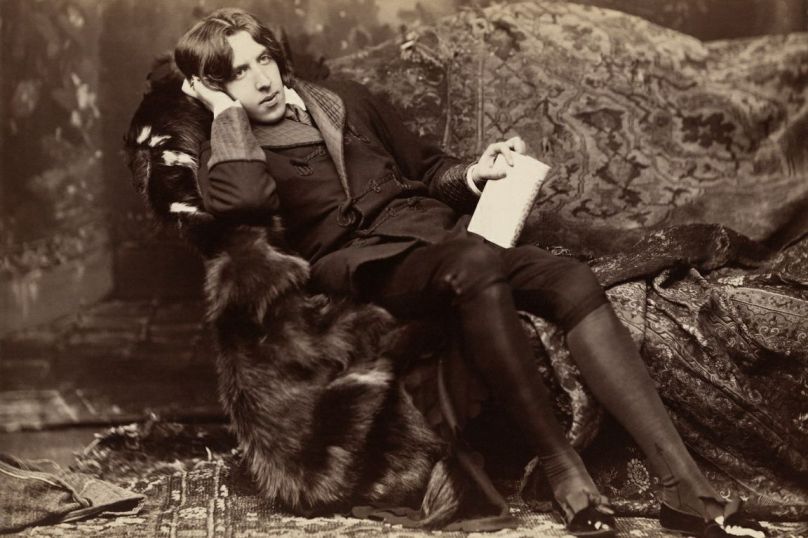
Space, Time, and Borges

Argentinean Poet Jorge Luis Borges (1899-1986)

Here is another great poem by Jorge Luis Borges, a poet who has had perhaps a greater influence on my life than any other. Among other things, my thirst for knowledge about him has led me to Buenos Aires three times in the last twenty years.

Limits

Of these streets that deepen the sunset,
There must be one (but which) that I’ve walked
Already one last time, indifferently
And without knowing it, submitting

To One who sets up omnipotent laws
And a secret and a rigid measure
For the shadows, the dreams, and forms
That work the warp and weft of this life.

If all things have a limit and a value
A last time nothing more and oblivion
Who can say to whom in this house
Unknowingly, we have said goodbye?

Already through the grey glass night ebbs
And among the stack of books that throws
A broken shadow on the unlit table,
There must be one I will never read.

In the South there’s more than one worn gate
With its masonry urns and prickly pear
Where my entrance is forbidden
As it were within a lithograph.

Forever there’s a door you have closed,
And a mirror that waits for you in vain;
The crossroad seems wide open to you
And there a four-faced Janus watches.

There is, amongst your memories, one
That has now been lost irreparably;
You’ll not be seen to visit that well
Under white sun or yellow moon.

Your voice cannot recapture what the Persian
Sang in his tongue of birds and roses,
When at sunset, as the light disperses,
You long to speak imperishable things.

And the incessant Rhone and the lake,
All that yesterday on which today I lean?
They will be as lost as that Carthage
The Romans erased with fire and salt.

At dawn I seem to hear a turbulent
Murmur of multitudes who slip away;
All who have loved me and forgotten;
Space, time and Borges now leaving me.

Oshogatsu

Elegant Japanese Kimonos

Today, Martine and I rode Metro Rail downtown to attend an event at the Central Library celebrating Japanese New Year, or Oshogatsu. In Japan, New Years is celebrated at the beginning of January, unlike Chinese New Year, which is based on a lunar calendar. So actually it was a little late to celebrate Japanese New Year, but I guess it was difficult to schedule the Mark Taper Auditorium at the library.

There were three main exhibits, each presented by a different locally-based Japanese-American organization.

The first was ikebana, or flower arranging. In twenty minutes, a young woman created a floral masterpiece consisting of two types of lilies, mums, pine and willow branches, and other plants. I wondered how the different components stayed in place. I learned that a kenzan, variously knoen in English as a “spiky frog” or “pin frog.” was used to hold the components in place. (See the photo below.)

Kenzan

The rest of the program consisted of a fashion show of different types of kimonos for women (and men as well as children), accompanied by music on the koto, a zither with thirteen or more strings. On stage were three kotos played in unison.

I was first introduced to the koto at Dartmouth College, where I heard a concert given by an accomplished Japanese soloist. That, and my love of Japanese films, have introduced me to the joys of Japanese koto music.

The kimonos for women were truly lovely. I was amazed however how intricate the obis (sashes) were and how long it took to tie them. A skilled kimono-wearer could tie an obi in four or five minutes. It would probably take a klutz like me the better part of the morning, only to end up with an unholy mess.